We have warmed the Earth, destroyed the forests and green cover, and made extinct thousands of animal and plant species. We are still plundering every bit of resource and respite our Earth had to offer. It is but natural that we also face the consequences of our careless acts.
Imagine a stretch of ocean with no form of life around. No fish, no corals, no sea grasses, no sea animals, no life; nothing. This is the dead zone in the sea. Once full of life with sea animals and plants – this dead zone in the sea is an ocean’s graveyard with ghosts of its past.
According to the latest reports by environmental agencies, oceans are now witnessing a severe damage causing pockets of lifelessness in the ocean waters. Life cannot thrive in here anymore. We are now witnessing an environmental disaster which is very difficult to undo.
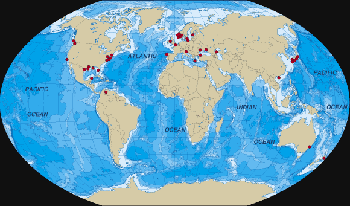
Environmentalists are now questioning the future of the oceans, the seas and its produce with which so many lives, livelihoods, eco-systems and food chains are connected. According to Gary Shaffer, Lead Scientist of the Niels Bohr Institute at the University of Copenhagen said it was unclear, in the grim light of this study, whether future generations could look to the oceans as a major reserve of food.
One of the major contributors to the dead zones is the dumping of agricultural and industrial wastes into sea water. Dead zones are mostly found around coastal areas where there is high industrial activity.
According to the UN Environment Programme flow of too many nutrients into the sea is causing major growth of algae, which in turn uses up the available sea oxygen. There has been a high increase in the number of oxygen-deprived “dead zones” in the world’s oceans, threatening fishes, fisheries as well as humans who depend on sea-life forms.
- Here is a brief on how the oceans and sea waters are slowly turning anoxic
- This is a lnk to an informative resource The Dead Zones: Oxygen-Starved Coastal Waters
But new reports have shed light on even more shocking facts. Dead zones are probably a direct consequence of global warming. This environmental disaster was so slow in its making that no one really saw it coming. It has been decades of environmental neglect that has caused oceans to breathe its life out.
As carbon emissions are steadily rising all over the world, the atmosphere is not able to contain and fix these emissions, leading to increase in the global atmospheric temperatures. The oceans and seas are turning warmer because of the trapped greenhouse gas – carbon dioxide
Increasing carbon levels in atmosphere leads to a warmer earth. This global warming causes change in atmospheric temperature and pressure due to which ice caps melt – adding mega volumes of fresh water into sea and altering its salinity levels. Any slight increase in global temperatures causes great harm to the environment as oceans circulation gets severely affected. When the ocean does not circulate enough, there is lack of oxygen distribution.
Where there is no oxygen – life cannot thrive. These anoxic – dead zones which do not have adequate oxygen do not support fish, seafood, corals reefs, marine ecosystem, shellfish, etc.
Sad but true, marine “dead zones” already exist today. They are continuously increasing in size and numbers. For Example, there is one dead zone in the Chesapeake Bay off the New York Coast covering about 1000 square kilometers. This single dead zone has an economic impact of around $500 billion every year, as commercial and recreational fisheries have severely been affected.
And if this was not enough, according to Robert Diaz, marine biologist of The College of William & Mary in Williamsburg, more than 235,000 tons of food is lost to oxygen-deprivation/ hypoxia in the Gulf of Mexico.
Added to these environmental crises is the fact that even if the entire world switched off its carbon emissions completely, it would still take hundreds of years for the waters to come back to normal. This phenomenon is not an instant on-off switch and would roughly take about 2000 years to react to any damage-control measures. It indeed takes a lot of time to heal.
The need of the hour is deep drastic cuts in carbon emissions in order to break the rate of acceleration with which the marine ecosystems are getting depleted and to ensure that our future generations experience a form of life – The Ocean.
Agricultural and industrial wastes need to be sanitized before being released into the seas. Harmful pesticides, fertilizers, sewage, animal waste, and chemical compounds needs to judiciously used and treated before being released into the sea. Burning and use of fossil fuels should drastically reduce to contain the carbon levels in atmosphere.
It had taken hundreds of years of damage to the earth and heated up the oceans… and now even hundreds of years, cannot cool the ocean to normal limits.
While one may heave a sigh of relief that these dead zones are still far away in regions such as South America, Europe, etc., and may not feel the need to act now.
Quick reality check: A dead zone in sea has been found in the west coastal region of India, in the Arabian Sea. Need we say more? Or is it still somebody else’s business to fix that?
Your in depth research and analysis are unbelievable, you are true messiah for all us all!
May we all take your words, your compassion, your knowledge and mentally catalogue all facts, and act upon them every day, each time we breathe, and as long as we live!
God bless your soul and God bless our planet.