Central Park, New York. Stanley Park, Vancouver. Hyde Park, London. KBR Park, Hyderabad. Hyderabad??
The reader may be a little nonplussed here. What is this park in Hyderabad and how does it figure with the three best urban parks in the world!
But let us give the devil or in this case the Hyderabad Urban Development Authority it’s due. And I do not speak as an armchair travel critic, having personally walked the length and breadth of the two of the three great parks – Stanley Park and Hyde Park. This is why I do not hold back in recognising our own local gem.
I travel almost every week on work by air. As the flight takes off, it rises over a mass of concrete, steel and glass a vast honeycomb of buildings connected by narrow channels we call roads. The eye is momentarily dazed and brain numbed by this endless stretch of urban cacophony. This suddenly gives way to a vast green oasis – the Kasu Brahmananda Reddy Park. A lifeline to the modern upmarket areas of Hyderabad. The park daily absorbs the vast quantity of CO2 being belched by thousands of bikes , autos , cars , buses that choke busy roads of Panjagutta, Banjara hills , Jubilee Hills , Hi Tech City, the residential and commercial hubs of twin cities.
The park’s green cover also sustains the only remaining free population of peacocks, mongoose and the like. It also provides curative and preventive therapy to nearby residents who take their daily morning exercise – walk or jog inside or around its vast premises.
So on a chilly December morning I convinced my relatives from Chennai that this was the place to be seen on par with sights like Golconda Fort and Salarjung museum. Not being great nature lovers or trekkers and this being compounded by the fact that they were lifelong residents of Chennai (a city devoid of “public” parks), they were quite sceptical. But in deference to their host they agreed to get up and be ready to reach the park at dawn 6.45 am
As expected the norms of Hyderabad standard time dictated that we reached the park a good half hour later than schedule. The winter sun was already up – a white shimmering ball dazzling the eyes but caressing the skin with only a hint of warmth. The ball was a stamp on the blue envelope above us. We parked and drunk in the bracing winter air. At the gate a forest department board with the standard green and blue background gave the historical and topographical details of the park. We bought tickets – a throwaway price of Rs 10 per adult and Rs 5 per child at the counter and entered the park. Straight away we met a board depicting the park on a map and decided to take the complete 4 km walking route. And what a walk it was.
A very clear increase in the chill factor inside the park made our Chennai guests don their jackets. There is at least a 3 degree drop in temperature as compared to the road a 100m away. The path is normal compacted clay and sand and lined by 6 inch high stone separators on either side clearly delineating the walking path from the forest. Milestones appear every 250 Mts, each one carrying a painted picture of bird or butterfly that can be spotted in the park. Conservation messages below the picture also make for interesting reading like
“He who planteth a tree is a servant of God”
Variations of the foliage are marked by plates giving the biological names of specific trees. Artificial ponds dot the route, most of them half dried in the 3 months since the last rains here. The first km is a bird watcher idyll – birds talking, singing, and calling in a symphonic range of octaves. Be patient follow the sound and you can spot the bird behind the voice. A pair of binoculars is a must for close sighting of warblers, barbets, sparrows, kingfishers and migratory birds like little egrets which are amongst the commonly visible avian life.
Km 1.00 is a small fenced landscaped lawn garden with ponds and benches to relax. Toilets and waste collection bins are clearly marked and provided here and at every succeeding km (2.0, 3.0, and4.0). Kms 2 and 3 are characterized by the national bird – Peacock. Lone peacocks, their brilliant blue green plumage fanned out to attract the dowdy looking green necked pea-hens. Families of peacocks and pea-hens, the little ones being quickly herded across the path in single file.
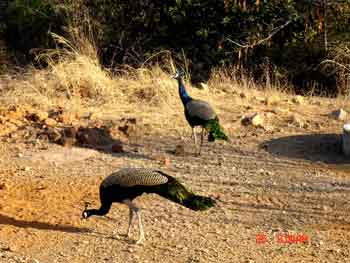
Peacocks on trees giving their harsh guttural howls – no doubt God has balanced their stunning visual beauty with a frightening voice. But make no mistake these birds are as shy as in any forest. Stop a minute near any of them and they scoot into the undergrowth before you can mouth “peacock”. As are the squirrels and occasional mongoose if you are lucky to see one, Km 4.0 is for fitness freak – a series of undulations giving ample scope to work out the upper and lower thigh muscles. This portion being parallel to the road , continuous hum of traffic and faint blaring of horns makes it more of a fast walking stretch than any serious bird watching.
As we complete km 4.0 which is basically back to scratch – our lungs have been filed with the goodness of oxygen , our heart rate past the 100 beats per minute mark thanks to fast walk on the last km , muscles well stretched out and oiled and the eyes sharpened through constant scanning for birds. The only sense we don’t use here and actually prevent use of is the throat or vocal chords. Like in any forest – it is best to speak only when emergency requires it.
The best part of KBR Park – No plastic, paper or any other artificial form of human waste. Not even a scrap can be found lying on any part of the park except close to the entrance. This too appears to have been blown in by the wind from the city outside. Can you imagine any such public place anywhere in an Indian metropolitan city that is plastic, paper and pan / cigarette foil free!
Secondly no human urinating or defecating inspite of the vast grounds of bushes and trees available. Just outside every foot path, electric pole or advertisement board structure is covered with human excrete especially urine.
And you see no picnickers playing ball or antakshari.
How is all this possible we may wonder? Here is how I saw it – Good infrastructure of toilets, dustbins benches backed by regular support services for cleaning, watering, maintaining supported on the foundation of clear communication – both at the entrance and at every stage inside the park.And above all, the initial practice of eco friendly behaviour by the regular walkers has become the visible standard for all subsequent entrants to live up to.
Three cheers for the KBR Park Management!!!
May we develop many more such entertainment spots in our cities thereby making them more liveable and educating the people at the same time.
Fact File
- Location: Jubilee Hills, Hyderabad
- Season: All year round
- Timing: 6-8 am and 4-6 pm
- Area: 156 hectares
- Flora: 600 species of trees, shrubs, grasses typical of southern tropical deciduous forests
- Fauna: Mammals like mongoose, hares, monitor lizards; about 115 species of birds, 15 butterfly species and 20 reptilian species
Very good post, Ganesh. It made me take a stroll down the memory lane. I studied and worked in that area, and my daily commute by the APSRTC bus was the most enjoyable part of the day. It felt great whenever the bus crossed the green belt… the whole mood would change.. a little upbeat and ecstatic. Never gave too much thought to it, but just lived for those moments. That happy feeling over nature still lingers on. Your post made me realise that it could have been that extra dose of oxygen that made me feel so. KBR Park is indeed Hyderabad’s jewel and I hope it remains green.
There is one more place called ‘The Lotus Pond’, which was earlier an unkempt water body – the watermen and buffaloes favourite joint. Midst the muck use to be lots of lovely blooming lotus flowers. Honestly, there was a lot of raw beauty in that place. I use to love that stretch too. Some builders association got together to clean it up. I dreaded that they would strip the place and assemble another iron-concrete-glass box with no parking lot. But to my surprise, it turned out to be a clean manicured garden. That same unkempt place is fashioned on the oriental design lines and is almost like a Zen garden. Surprisingly, that pond and garden has made its way through the leading design magazines.
I do miss the raw and unkempt beauty of the pond. I applaud the fact that the authorities have not chopped the trees, displaced the huge boulders, in order to green that patch. As long as the old trees are not cut and more greenery is planted, we are not complaining.
Urban green landscapes are indeed a way to the future.
you are right..urban greening is a must for city dwellers to have some relief in their lives. daily commuting to and from work is so horrendous, actually found a visit to the park more entertaining than going to a movie.
It is really a unique park of its kind and very well maintained. There is shortage of water and it is very dry in the summer days. It appeared very strange to me to read in the noticeboard, that photography is prohibited inside the park. Photography also adds to the conservation efforts.
Looks like I missed the notice board…because I use my camera there all the time..will share the pics on this forum soon