• Skip to primary navigation
  • Skip to main content
  • Skip to primary sidebar

Treesouls

  • About Us
  • Contact Us
  • The Green Team
  • What we do

To Bt Brinjal or not to – Should Bt Brinjal stay a midsummer night’s dream in India?

April 7, 2010 by Leave a Comment

The recent no go to release of Bt Brinjal by the environment minister in India has  thrown a spanner into the aspirations of proponents of genetically modified (GM) crops. The status quo defined by the indefinite moratorium is not just a breather for the environmentally conscious brethren but also an opportunity for everyone to evaluate, understand and think for oneself the long term risks and myths associated with GM crops in general and with what is in stake for an agriculture economy like India.

The big debates going on in the wake of the Bt Brinjal episode might seem like much ado about nothing to the average Indian, burdened as it is with his priority needs of food, shelter and clothing and more like hyperbole of the highest order to the social climber in the rat race.

Whatever be, there is much at stake for the discerning eye. And it is all the more important because it concerns each one of us, our day to day existence in terms of health, environment, food prices, our agrarian framework and more vitally pertinent, the future of our children.

When a food like Bt Brinjal is introduced, the regulatory mechanism has to be above suspicion – Abhijit Sen, Member, Planning Commission

With all the heat and noise raised over this issue, it is a no brainer that to take a black and white position will definitely not provide satisfactory solutions. The broader perspective needs to rein in knee jerk reactions. A conflux of factors need to be factored in – human health, fool proof testing and regulation, greater transparency in the whole process of allowing stakeholders to control seed and agrichemical production, multinational companies and their subjective business goals and the like.
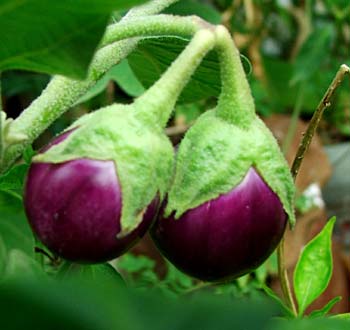
Pix Credits - Senthilkumar Aanand

The quick links that sprout below are just a pointer to the stakes involved, more as a precursor for one to think rationally on the key priority aspects that drive food security for future generations and definitely the prime drivers that have made many genetic engineering scientists ask for stringent testing rigor, threadbare technical reviews, scientific standards, credible methodologies and objective analysis as far as introduction of Bt Brinjal in India is concerned.

  • Reasons for the Bt Brinjal moratorium
  • Bt Brinjal: fears, myths and facts
  • Bt Brinjal: The Way Forward for GM Crops in Indian Agriculture
  • Sickness and death in animals exposed to Bt cotton
  • GM Food Can Cause Cancer
  • Monsanto’s Harvest of Fear

What the whole issues has also brought to the fore is the need for a proper reassessment of our agriculture policy, its alignment and investment vis a vis alternative biotechnologies.

Well, if the Biotechnology Regulatory Authority of India (BRAI) Bill to be introduced in Parliament is a harbinger of things to come, all debate really seem much ado about nothing.
Filed Under: Uncategorized

Deep Ecology and Conservation of Nature – Lecture by John Seed in Chennai

January 22, 2010 by 22 Comments

One Fine Day, 1973: A young systems engineer at a leading company left his job walked into the open wide world. Having had his share of daily grind, he longed for something more; something beyond. He took a journey within – followed Buddhism, meditated, organized meditation retreats and by chance stumbled into environmentalism.

He got himself involved in ecological conservation of the virgin rainforests of Australia which were under threat then. It was during these pursuits and demonstrations that he felt himself connect with the emotional and spiritual side of the Earth. He felt himself respond to Earth in dimensions other than the five senses. He realized that his work went beyond ecological conservation and was fighting for Life on the planet and for the planet itself – which is alive.

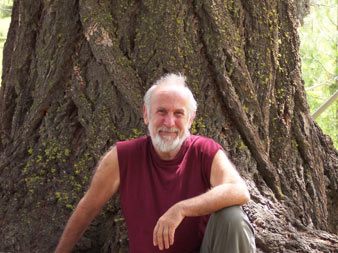
He is Australian Rainforest Protection Activist – John Seed.

26th December 2009, Chennai: A youthful old man on the dais was talking about Deep Ecology while strumming his guitar, singing poems and love songs for Earth. As a part of his lecture tour to India, he came to reiterate his message of the living Earth, and how we have forgotten to connect with it. He was John Seed in person – live, talking, and singing his beliefs.

John Seed - Rainforest Conservation Activist

John Seed needs no introduction as he is a well known face of rainforest activism. Having worked for 30 years for the protection of rainforests worldwide, John is still going strong in his message to protect our living Earth.

What is remarkable about his life story is that he did not drop from the sky. He was an ordinary human being and a normal person like you and me. He still is. He has a life, loved ones, fears, and his share of daily grind; just like we all do. But he had the courage to keep it all aside and dive head long into the ideals that grew in him.

He did not start with a big bang or an NGO. He simply tagged himself with the causes he could feel within and connect to. He learnt on the fly. He learnt what he was fighting about, after getting involved in the fight. All he had was a bit of conviction that he was doing the right thing. He did come a long and is raring to go for more.

As a part of his lecture tour to India, John Seed has been travelling all over the country talking about Deep Ecology, Rainforest Conservation, and his past works in different parts of the worlds. His talk in Chennai was centered on the efforts in stalling development of neutrino observatory, and various ecological conservation work undertaken in different parts of the world.

John Seed’s Role in Stalling the Neutrino Observatory in Niligiri Biosphere, Tamil Nadu

India-based Neutrino Observatory (INO) was a proposed particle physics research project to study atmospheric neutrinos in a large deep tunnel/ cave near Masinagudi in Tamil Nadu, India. It was one of the biggest experimental particle physics projects to be undertaken by multiple institutions, for the first time in India. The proposed project location falls near the Mudumalai Wildlife Sanctuary (Tamil Nadu) which is rich in wild biodiversity putting two tiger reserves and elephant corridor at Singara, at risk.

As a part of the experiment, more than 2 kilometer tunnel would have been constructed to build an underground 100,000 ton neutrino detector. This Neutrino Observatory was planned to be constructed in the heart of the forest region of Singara, the Nilgiri Biosphere Reserve (NBR).

Within the Niligiri Reserve lie six protected areas (PAs) – The Wynad Wildlife Sanctuary, Nagarhole National Park, Bandipur National Park and Mudumalai Tiger Reserves and the Mukurthi National Park and Silent Valley National Park. All these protected areas which house rare and endangered species, including the Tiger. Large tracts of reserve forests connect these different National Parks and Sanctuaries and form more or less continuous forests from the animal’s point of view.

Immense care would have been required during construction and operation phase as the area is a corridor for the movement of Elephants. The proposed site’s access road was cutting across a vital elephant corridor that connects the Eastern Ghats and Western Ghats. Needless to say that this project would have spelt doom to the elephant, tiger and many other animals habitats and also affecting the flora of the region.

In November 2009, the Ministry of Environment (India), denied permission for the Department of Atomic Energy (India) to set up the India-based Neutrino Observatory (INO) project at Singara.

John Seed played a major role in stalling the Neutrino Observatory project. He started his email campaign by sending letters to the project stakeholders such as the politicians, scientists, administrators, including the government. The awareness of the erstwhile unknown project caused media uproar and this project was stalled at its design stage.

Thanks to John Seed and many more environmentalists and activists like him, many species of the Niligiri were saved from intrusion and gradual extinction. John Seed’s work towards ecological conservation in India had resulted in saving the Niligiri Biosphere and its fragile ecosystem.

Deep Ecology and Conservation of Nature – Lecture by John Seed in Chennai

On 26th December 2009, John Seed, as a part of his second lecture tour to India spoke about Deep Ecology. Here is introduction on his program.

Deep Ecology is a philosophy of nature, which sees that underlying the environmental crisis there is a psychological or spiritual disease stemming from the illusion of separation between humans and the rest of the natural world. The late Arne Naess, Emeritus Professor of Philosophy from Oslo University, Norway, who coined the term “deep ecology”, pointed out that our “ecological ideas are not enough to protect the Earth, we need ecological identity, ecological self”. With a presentation that includes music and poetry, John Seed shows us how to nourish our ecological identity and align ourselves with Earth.

The experience of deep ecology leads to a deepening of our love for the natural world and empowerment and vision for the protection of Nature. In the 2nd part of this presentation, John will speak of this and show a couple of short films about his projects for the protection of nature in South India including the reforestation of Arunachala in Tamil Nadu and the protection of the world’s largest remaining population of wild Asian elephants in the Nilgiris.

John Seed’s lecture was fun, interesting, enlightening and musical. We were more than happy with his rendition of songs and poems. He shared his experience in Thailand, where Buddhist monks tie a saffron cloth around a tree deeming it sacred. The wood cutters do not cut such trees. By this some trees are being saved. And in Sri Lanka, sacred grooves are earmarked and no one harms those. These are the indigenous ways in which the clergy is trying to reach out to protect Mother Nature.

He also spoke about the remarkable work undertaken by Annamalai Forest Restoration Foundation where trees were planted and protected on the mountains in an ingenious way, inspite of dry weather conditions. Thanks to efforts like these, there have been no major forest fires in Tiruamnnamalai inspite of the harsh dry climate.

He also spoke about the community therapy programs that are conducted by him and his organization that involves healing of people, sensitizing them to the environment, etc. Between Deep Ecology and paeans of love for Earth we were treated with video footage of some fabulous work by India’s ace wildlife film maker, Shekar Dattari. Here are some of the video clippings.

Reweaving Shiva’s Robes

Long Live the Elephants

John Seed’s passion for Earth was felt through out session. He is one of the remarkable persons who have done their bit and continue to do so. The key messages he left for us were:

> We are trying to save the Earth now, because we are worried about us; not the Earth.
> That we live in an illusion that humans are central to everything on Earth.
>Earth has always said YES to human beings. It still does.
>That what happens to nature, happens to us.
>That we are living in a world of wounds – wherein its hard to think about ecology.
>That religions and religious postulates have bred in arrogance in humans since time immemorial(going by the story of creation).
>That our language deceives us to believe that we are better. And that plants and animals that do not speak are inferior.
>That you don’t have to go too far for answers. Nature is explanation itself.

Here are some of the soul warming songs that John Seed sang and strummed in Chennai at the Book Point Auditorium (Anna Salai):

>I just wanna celebrate; celebrate life…
>Now the Lord made the world in just six days
>Love Song to the Universe – Remember that you are standing on a plant that is evolving…
>Ode to the Mother – I was once blind…

You can find the lyrics and music notes of these poems and songs and a collection of more soul warming songs on his website.

To know more about John Seed, the founder and director of the Rainforest Information Centre in Australia, please visit his Rainforest Information Website

Filed Under: Uncategorized

Anupam Mishra’s TED Talk on the Ancient Ingenuity of Water Harvesting

December 11, 2009 by 6 Comments

You cannot miss Anupam Mishra is you are into eco-conservation and from India. He is an ancient soul living in this modern world, continually enlightening us, reviving the ancient water conservation and harvesting methods and more. A man most humble and his work outstanding, words dont suffice when it comes to presenting his body of work.

Anupam Mishra’s recent talk on TED forum on the ancient systems of water harvesting has taken the internet blogging community by storm. His emphasis on ‘respect’ and ‘ingenuity’ for the ancient systems is one aspect that is grossly overlooked in today’s green revolution. It is a reminder of how our fore-fathers merged infrastructural design with aesthetics, artistic expression and worship. Modern eco-conscious citizens have now come to know that water harvesting is not a recent invention but an ancient practice in India, actively used since thousands of years ago and that the ingenuity of ecological conservation is not a concept but a way of life for most citizens of the country.

ted_logo This is no audio-video jazz presentation but a feast to the inner soul. A talk that will once again make feel humbled, proud and ashamed. A talk that will urge us to keep our technology and decades of learning aside and makes us want to use our minds once again. Have a look (and dont miss out the visuals).

About Anupam Mishra and his Work:
Anupam Mishra is among the most knowledgeable persons in India on traditional water harvesting systems. He travels across water-challenged India studying rainwater harvesting methods and learning from the people behind them. He presents his findings to NGOs, development agencies and environmental groups, pulling from centuries of indigenous wisdom that has found water for drinking and irrigation even in extremely arid landscapes through wells, filter ponds and other catchment systems.

A founding member of the Gandhi Peace Foundation, Mishra is working to bridge the gap between modern water management technology and India’s heritage of water harvesting, so that every community is self-sustainable and efficiently safekeeping an increasingly scarce and precious resource.

The mission of the Gandhi Peace Foundation is to promote the environmental activities of rural development agencies; to prepare survey reports on distressed areas and place them before concerned authorities; to disseminate environmental information through the publication of up-to-date reports on environmental issues; to organise workshops and seminars for environmental experts, policy makers, individuals and organisations engaged in environmental issues.

Contact Details:
Gandhi Peace Foundation
221 – 223, Deendayal Upadhyaya Marg,
New Delhi 110 002
Tel: 23237491, 23237493

Filed Under: Uncategorized

Gift a Green Plant – DIY Ecofriendly Party Favors and Gifts for Kids

August 15, 2009 by 13 Comments

Here is an exciting and simple project for you and your kids to do this upcoming party season! Make your own party favors – the green way. Gift away plants and trees to bring in the much needed eco-friendly practices in our daily lives.

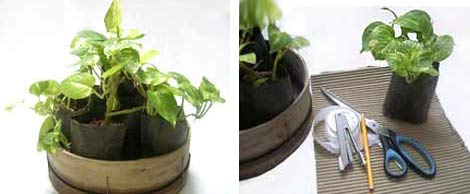
Green Gifts - Money Plant Gift Wrapped in Corrugated Paper

When my son came back home from a birthday party with party favor bags with plastic and lots of extra-sugary candies, it really made me think (or I was aghast rather) about the kind of life and lifestyle example we set for our kids. We did not want to follow this tradition. The birth-day was no doubt special for us, but we wanted a bit more out of it. We wanted to share something that was close to our hearts and to give the best we could – to all the lovely little kids.

I believe that implementing or embarking eco-friendly practices was a great way to celebrate special occasions. By planting trees or gifting trees, we not only teach and learn about the concept of sharing, but also implant a sense of belonging to the nature.

Giving a small plant as a gift seemed as the most beautiful idea to me. Even though the kids are two plus tiny tots, I thought that they could begin right away. My inspiration to give plants as give-aways came from the lovely time me and my kid have when we sponge clean and water our home plants. Instead of gifting trees, small plants would be a better option for kids as they will be able to see steady growth in the plant, if well cared for. They can tend to it, water it, sponge the leaves and learn a lot more about plant life and hope fully, they will get to love plants and trees as much as we do.

Tutorial on Gift Wrapping Plants as Party Favors

Money plant (Botanical Name: Epipremnum aureum) was the only option I could narrow down to. This easy-to-care-for plant is native to the land, grows easily, can be kept indoors, and more over, very beautiful to look at. I could not think of any other plant species that could be so versatile for kids to tinker with while they learn and get closer to nature. I went to a near-by plant nursery along with my son to select the money plants for his friends. He loved the visit and the experience. We came back with two boxes full of little plants – ready to be gift-wrapped by us. 

Batch of Money Plants Ready to be Gift Wrapped
Try to use whatever material you have in your house instead of trying to go out and buy materials from the market. Otherwise it defeats the purpose. Most of the time, creativity with limited resources has beautiful results and that’s the beauty of going green. I had a roll of cheap corrugated paper that needed quick disposal. A stapler, scissors and a little piece of ribbon got the creative juices flowing.
Protecting and Marking the Plants before Gift Wrapping

If you are going to gift the plant after a day or two, it’s a better idea to wrap the plant pack with some left-over plastic paper or bags to ensure that there is no water leakage after packaging as it may wet the corrugated paper.

Assess how much paper will be needed to wrap around the plant. Leave some paper at the bottom for folding into flaps.  Take only what you need and cut the required amount of paper. Form a roll and staple it to keep the shape and size secured.

Marking and Stapling the Corrugated Paper Wrap - Ecofriendly Gift Wrapping Tutorial

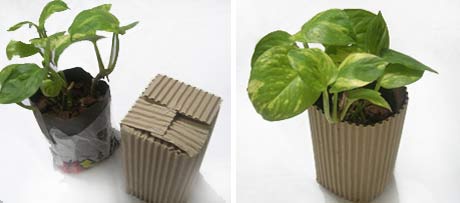
This stapled roll needs be closed athe bottom. Cut four equidistant slits and fold them inwards to form a box cover like flaps. These flaps can be stapled or glued to each other and sealed.  

Cutting and Folding the Corrugated Paper to Form a Small Pack to Hold the Plant Gift

The roll looks like a bucket with one open end and the other open. Insert the plant in the corrugated paper bag and adjust it till it stands well independently.

Corrugated Paper Parcel with Plant Inserted as a Small Gift

Cut a thick strip of corrugated paper and run it along the sides of this pack, though the bottom and back. Ensure that the strip goes under the bag to provide the reinforcement as mud can be quite heavy.

Wrap around the Corrugated Ribbon as a Handle for the Gift

Staple at points which ensure that the handle is sturdy. You should be able to pick up the plant by its handle comfortably. The bag is ready but it can be made prettier. 

With or Without Satin Ribbons - your Organic Gift Pack sits Pretty

Since no gift is complete with our satin ribbons bow-tied, chose the ribbon color of your choice or according to the selected theme and make big bows to add your personal touch. An ecofriendly alternative is to make corrugated paper bows or leaves and tie them around or use grass cords.

Batch of Gift Wrapped Plants as Party Return Gifts for Kids

Do not be inhibited while doing what you feel is right. All I along this exercise, I was hoping that this exercise does not fall flat or that we come across as un-cool parents. But the response was beautiful and over-whelming. Everyone loved the gifts and appreciated the effort that went behind making it. Needless to say, the birthday turned out to extra special for all of us.

Filed Under: Uncategorized

Revival of Traditional and Eco-Friendly Hand Block Printing in Bagru, Rajasthan

July 4, 2009 by 48 Comments

The Beautiful Hand Block Design Motif of Bagru

Bagru, an erstwhile sleepy and desolate village on the Jaipur-Ajmer Road in Rajasthan, is now the cynosure of many fashion houses and boutiques.

As the world is waking up to environmental consciousness and eco-living, this little village has been attracting the attention of green moguls as one of the must-have items in your home wardrobe. What draws the crowds is its ancient art and craft form that is high on ecological consciousness and for its use of eco-friendly hand block printing practices.

Bagru boasts of a handful of crafts persons who still use traditional vegetable dyes in their hand block prints. Bagru’s method of printing is completely eco-friendly. From treating the base cloth with Fuller’s earth (multani mitti), soaking it in turmeric (haldi), to stamping the cloth with beautifully patterned blocks of wood using natural dyes of earthy hues, Bagru’s prints are epitome of eco-friendly textiles and printing practices. Added to that, natural coloring agents such as alum, turmeric, pomegranate, dried flowers, indigo, etc are used to add colorful designs and motifs to the fabric. Blue from indigo, green from indigo mixed with pomegranate rinds, red from madder root and yellow from turmeric. It can’t get any more eco-friendlier than this.

Bagru Design Detail with Threadwork

Since India is rich and abundant in its natural resources, most of its arts and craft forms derive raw materials and design influence from nature. Almost all the ancient art forms are eco-friendly and mostly celebrating nature. Bagru’s hand block printed fabric is no exception. From vegetable dyes, natural fabrics, nature-inspired patterns and design, its products are ecologically natural.

Bagru prints are so unique and renowned that the Calico Museum of Textile in Ahmedabad, India, has commissioned a study into this old art form. Thanks to this kind of interest in ecofriendly printing practices, the village now hums with much activity: stamping, printing, dyeing and supplying the exquisite art form to different corners of the world.

In spite of poor living and working conditions, the expert craftsmen of Bagru have kept the three-centuries-old tradition of block printing alive in India. Thanks to them, we now get to witness and ancient art form that shows how man lived in symphony with nature without harming the environment and oneself.

Bagru Prints in Home Decor

History of Bagru Hand Block Printing
There is no authentic record for reference on backdating Bagru’s block printing practices. It is estimated that this art form was introduced 450 years back when a community of Chhipas (literally meaning people who stamp or print) came to Bagru from Sawai Madhopur (Alwar), and settled in Bagru. Even today, their community works together in a place called Chhippa Mohalla (Printer’s Quarters), by the Sanjaria riverside. It is perhaps the river name that lends it name to Sanganeri printing art form.

The Chippas community settled along the riverside, like any other nomadic settlement. The bank of the river provided then with clay which is an important ingredient in getting the base color of the famed Bagru prints. The artisans smear the cloth with Fuller’s earth got from the riverside and then dip it in turmeric water to get the beige colored background. After that, they stamp the cloth with beautiful designs using natural dyes of earthly shades.

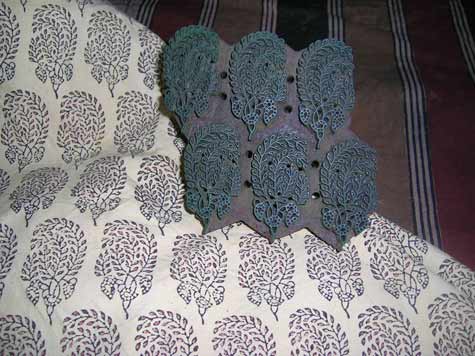
Hand Printing Blocks - Teakwood & Rhodha

Eco Friendly Colors used in Bagru Hand Block Printing
Bagru prints are done on off-white, ivory white, or beige background. The main colors used in Bagru printing are black, red and maroon. These three main colors are extracted from naturally occurring sources: black is derived from worn-out iron horse or camel shoes soaked in water, red comes from gum paste and phitkari, and maroon is a result of mixing the above two colors.

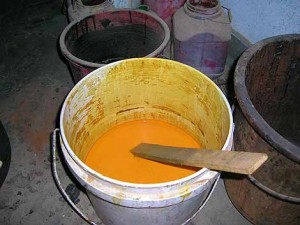
Turmeric used as Vegetable Dye for Eco-Friendly Hand Printing Technique in Bagru

Apart from these base colors, natural vegetable dyes are used to add colorful patters and designs. These include madder, indigo, pomegranate rind, turmeric, etc. Pigment colors such as green, rust, blue, violet, brown, and pink are added to appease wider markets. There is also a traditional reason for picking a particular color in the designs, such as indigo for Lord Krishna, saffron for a saint or yogi, yellow for spring season, etc.

Bagru Hand Block Printing Process
Bagru’s method of hand block printing is a labour-intensive process that requires a lot of, skill, patience, effort and time.

Bagru's Teak Wook Hand Blocks

The wooden blocks used for printing a design on the fabric are hand-made using traditional fine-carpentry tools. Some blocks are made of teakwood while some use light-weight wood called Rorda. These blocks are soaked overnight in oils, washed and then put to use. Usually, over a period of time, the Chhippas have considerable amount of blocks collection which they consider as their core wealth.

Stack of Hand Blocks used for Printing

The base cloth on which the block printing is done is prepared with riverside clay, turmeric, and other solutions to make it softer and absorbent. It is then dried and washed whilst acquiring a dull white or light beige color. This color background is one of the distinctive characteristics of Bagru hand prints.

Base cloth dyed with vegetable colors - Ready for Stamping

The vegetable dyes are prepared as per family traditions that have been passed from generation to generation. The printer dabs the block in the dye and stamps the design outline on the fabric as per the pattern template. Single measured dab is required for one stamp. There are no hi-fi tools to stamp but simple human judgment in assessing the amount of color required and in placing the block on the fabric. This imperfect yet neat stamping process lends it own unique charm to the design and product.

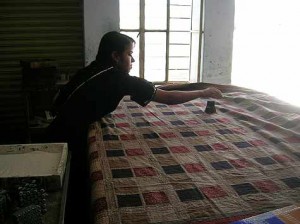
Hand Block Printing on a Bedsheet using Vegetable Dyes

Once the cloth has been printed, it is dried in the sun and then readied for dyeing. The design outlines are then filled with other color dyes with the help of complimentary hand blocks that are carved to fill the hollow spaces created by the outlined design blocks.

After printing, washing, and dyeing, the cloth is given a final wash and is sun-dried.

Difference between Sanganeri and Bagru Prints
Whilst both the eco-friendly printing forms belong to Rajasthan and use hand blocks, Sanganeri prints are usually done on bright colored fabric as a base. Sanganeri prints are found on bright white background whereas Bagru prints are done on black, brown, beige, and red back grounds. Sanganeri prints are mostly floral trellis like patterns whereas Bagru prints have motifs and geometrical inlays.

Difference between Dabu printing and Bagru Printing
Dabu printing is also a unique art form found alongside Bagru prints. In this, a design is sketched onto the background cloth. This sketched design is covered with clay on which saw dust is sprinkled. The saw dust sticks to the cloth as the clay dries. Thereafter, the entire cloth is dyed in select colors. The area where clay and sawdust mixture is present does not catch the dye and remains colorless. After dyeing and drying, the cloth is washed to remove the clay and the mixture. For additional color, this cloth is dyed again in a lighter shade to cover the patterned area. This unique form of printing is also environmentally non-toxic and uses no harmful or synthetic dyes.

The Dark Side of Bagru Block Printing
Like any other trade, Bagru’s block printing also comes under considerable flak for its adultery in art form. While retailers sell Bagru products at a premium price, a fraction of this reaches the actual workers. The printers are looking out for cheaper, faster options of increasing the output – putting this trade at a risk.

Market demand, poverty, poor living and working conditions have forced these craftsmen to resort to trade shortcuts that range from using synthetic dyes, machine cut tools, to fabrics of sub-standard quality.

The Future of Bagru Printing
Bagru block printing has evolved over a period of time accommodating to changes in lifestyle, demand and fashion. Since ancient and exotic art forms had taken a back seat due to western influence and globalization, many Chhippas have given up the art of hand block printing as people have adopted modern and synthetic textiles. Yet there are a handful of craftsmen who swear by the beauty of the art form and equate their work to worship.

While traditional art forms and methods are increasingly being replaced by modern tools, techniques and synthetic dyes, Bagru prints are finally getting recognized. With attention back on preserving the near extinct art forms, there is a revived interest in preserving the rare art of hand block printing with vegetable dyes.

Bagru prints are unique, captivating and exotic. Erstwhile used for clothes and turbans, Bagru textiles are increasingly in demand for home furnishings and décor. Bagru prints and motifs are preferred for bed spreads, bed sheets, table linen, and home accessories.

Bagru prints are here to stay. As people around the world are increasingly becoming environmentally conscious, soft-on-nature art forms are once again back in demand. Many block printers may now follow Bagru’s example of stamping it right.

Heaps of Hand Block Printed Textiles in Bagru - Ready for Export

Resources on Bagru’s Famed Hand Block Printing
For more information on Bagru Hand Block Printing process – click here   and here is a lovely collection of some beautiful and exotic motifs of Bagru Block printing


This article is based on a visit to Bagru Village, Rajasthan, for Hand Block Printing. We deeply appreciate the hospitality of the Hand Block printers, their families and other villagers – as we continue to admire their works of art which now adorn our home.

On our way back, we came across a heart-warming sight – a bunch of kids were studying under a lone tree in the desert, which is their makeshift school. The need of the hour is support in terms of infrastructure, education, finance, etc, for upliftment of the Bagru community.

For information on reaching Bagru or buying thier merchandise, get in touch with us.

.

Filed Under: Uncategorized

Rainforest Retreat – The real face of Eco Tourism

July 2, 2009 by 1 Comment

This summer, we took our family vacation in the southern part of Karnataka, a region famed for the biodiversity of the western ghats and of course the world renowned national parks at Bandipur and Nagarhole. Our first halt was at Madikeri (formerly Mercara), the district headquarters of Coorg. Coorg is India’s coffee country – characterized by sprawling coffee estates set amidst rolling hills.

Our two night stay was booked at the Rainforest Retreat located about 5-6 kms beyond Madikeri town. In their website the retreat claims to be an ecological hotspot run by two former scientists (husband and wife) of the Forestry Institute. The property is basically a 25 acre organic farm growing coffee and spices – cardamom, pepper, vanilla etc with a few cottages and couple of tents being allotted to the Retreat for tourists.

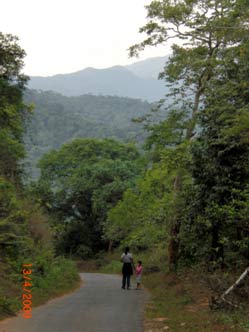
Directions from Madikeri were simple – follow the Club Mahindra sign boards and once you pass Club Mahindra, turn off at a school and drive the 3.5 kms to the Retreat. This last 3.5 km was through a winding country road hemmed in on both sides by thick rain forest interspersed with a few farms. Lantana in various hues – purple, orange –yellow, red overhung the road and the air was heavy with humid scents. We met but a single auto winding up in the opposite direction during this journey of 15 minutes and finally reached the gate.

Road to the RainForest Retreat

Ingrid, the manager welcomed us and one of the plantation workers doubling up as bell boy showed us to our room in the Cottage. Our two day stay here was a real eye opening experience in what eco tourism should really be about. Having read about other so called high profile eco lodges and having actually stayed in a couple of them – the simplicity in design and approach at Rainforest Retreat won our hearts and minds. Firstly some salient features about the rooms.

No electric power; there are no power lines to this place. How does one survive then?

Firstly, its location nestled in a small cusp surrounded by hills and under the huge canopy of rainforest trees makes modern amenities like air conditioning and even fans irrelevant even in height of summer. The rooms are designed for cross ventilation – open the windows in the daytime and the door and a delightful breeze will caress your skin. The temperature as in any forest drops at night, and one needs to shut the windows unless you want to share your bed with some of the creepy crawlies unique to the rainforest – snails, centipedes, the atlas moth (world’s largest winged moth), beetles and snakes are some of the neighbours here. In mid day, one can also relax or take a nap in the hammocks hanging next to the stream in front of the cottage, swaying in the strong breeze.

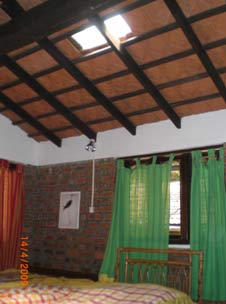
Light is required for reading or seeing ones way around the room and bathroom. The sloping slate roof of the room has two eyes – skylights cut out near the centre through which natural sunlight filters in. Additional light from the open windows is actually a bonus. There are CFLs in the room and bathroom. Power for these comes in after dark. The Retreat operates on solar power generated through their own panels. The cells get charged through the day and the stored power is used at night.

Skylights in the room

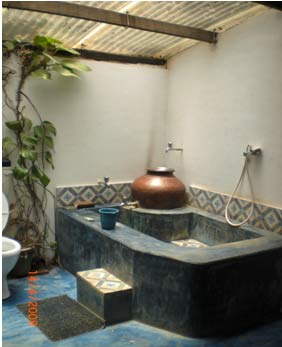
The bathroom has a translucent corrugated roofing of some form of plexi-glass which allows sunlight to fill up the entire area while at the same time making it impossible for anyone to see inside. Even our clothes could be washed and dried within the day time by hanging it in the bathroom itself.

Hot Water Cistern
Hot Water Cistern

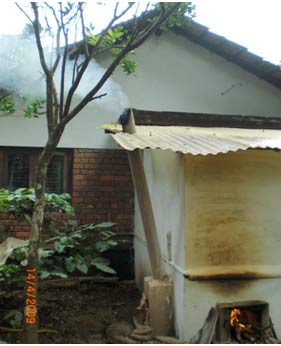
Since nights are pretty cool, having the morning bath in hot water would seem a necessity. This is also beautifully taken care of. A large earthen cistern is part of the bathroom. The cistern can be filled by a tap above it. Every morning, a bunch of firewood is lit under the cistern – a cavity under it accessed from outside the cottage is used by the staff for this purpose. Firewood comprises of the dead or fallen twigs and small branches which are available in plenty on the premises and the trees regenerate quickly in the monsoon rains. A chimney is provided to take the smoke out and the water remains hot for at least a couple of hours after heating.

Heating water with firewood

Natural soap (ayurvedic) is provided. Any water other than from the toilet is channelled out of the bathroom directly into the garden outside thereby ensuring even this water is used productively. Drainage is provided only for the toilet.

Food is simple and wholesome. Dishes are a mix of Coorgi, south Indian, north Indian and international cuisines – made with mostly organic vegetables, pulses and spices some of which are grown in the plantation and the rest sourced from other organic farms in the area. A simple hut open on the sides and supported by a conical roof on pillars is the dining area. Food is placed in casseroles on a side table of granite stone. Simple stainless steel plates and tumblers are used for eating and are placed in a bin afterwards. This is then washed by a couple of the women staff.

Nature is the only entertainment here and there is plenty of it. No TV. No signal for the cell phone or internet. No music ,loud or otherwise. One can read. Walk around the 25 acre plantation observing the varied plant, insect and bird life. Early mornings are filled with music of a different kind – the sing song bird calls of the rainforest. A couple of good bird watching spots are available a short walk away. The Retreat staff (mr.Ravi) is well informed and takes you on a 3 hour trek through the surrounding countryside and plantations upto the Galibeedu ridge. You can also do the 3 km wlak down to the river below (in the evening); be prepared for the steep and continuous climb back up to the Retreat.

All in all this is what eco tourim really should be all about. It allows one to be alone with nature, soak into nature and really observe and understand God’s scheme of things on earth. It ensures that whatever we do whether it is eat, sleep, bathe or read is done without disturbing nature. And while making our stay so comfortable, ensures that resources consumed are regenerated.

The simple underlying message is

Do not waste whatever you have and give back to nature whatever you take

By doing this you take care of the environment and it takes care of you.

As we left after our 2 day stay I felt a lot healthier both in body and mind than I have been in a long time. If two days can do this, wonder what living all the time in such an environment would be like!

Filed Under: Uncategorized

  • « Go to Previous Page
  • Page 1
  • Page 2
  • Page 3
  • Page 4
  • Page 5
  • Interim pages omitted …
  • Page 11
  • Go to Next Page »

Primary Sidebar

Recent Posts

  • Plastic – The New God
  • Plastic Bottle (a premonition or a prophecy?)
  • Energy Waste – Burning up our future!
  • Everyday is Earth Day
  • Fight Wildlife Poaching in Sumatra – Time to vote for Trevor Frost

Recent Comments

  1. divya on Revival of Traditional and Eco-Friendly Hand Block Printing in Bagru, Rajasthan
  2. Subhadra on Revival of Traditional and Eco-Friendly Hand Block Printing in Bagru, Rajasthan
  3. Chaiti Patel on Revival of Traditional and Eco-Friendly Hand Block Printing in Bagru, Rajasthan
  4. RITIKA GUNAWAT on Bishnois -The Sacred Environmentalists
  5. nishat on Revival of Traditional and Eco-Friendly Hand Block Printing in Bagru, Rajasthan

Archives

  • July 2011
  • June 2011
  • March 2011
  • November 2010
  • October 2010
  • July 2010
  • June 2010
  • April 2010
  • January 2010
  • December 2009
  • August 2009
  • July 2009
  • June 2009
  • May 2009
  • February 2009
  • January 2009
  • November 2008
  • September 2008
  • August 2008
  • July 2008
  • June 2008
  • April 2008
  • March 2008
  • February 2008
  • January 2008
  • December 2007
  • November 2007

Categories

  • No categories

Design

With an emphasis on typography, white space, and mobile-optimized design, your website will look absolutely breathtaking.

Learn more about design.

Content

Our team will teach you the art of writing audience-focused content that will help you achieve the success you truly deserve.

Learn more about content.

Copyright © 2026 · Genesis Sample on Genesis Framework · WordPress · Log in