One Fine Day, 1973: A young systems engineer at a leading company left his job walked into the open wide world. Having had his share of daily grind, he longed for something more; something beyond. He took a journey within – followed Buddhism, meditated, organized meditation retreats and by chance stumbled into environmentalism.
He got himself involved in ecological conservation of the virgin rainforests of Australia which were under threat then. It was during these pursuits and demonstrations that he felt himself connect with the emotional and spiritual side of the Earth. He felt himself respond to Earth in dimensions other than the five senses. He realized that his work went beyond ecological conservation and was fighting for Life on the planet and for the planet itself – which is alive.
He is Australian Rainforest Protection Activist – John Seed.
26th December 2009, Chennai: A youthful old man on the dais was talking about Deep Ecology while strumming his guitar, singing poems and love songs for Earth. As a part of his lecture tour to India, he came to reiterate his message of the living Earth, and how we have forgotten to connect with it. He was John Seed in person – live, talking, and singing his beliefs.
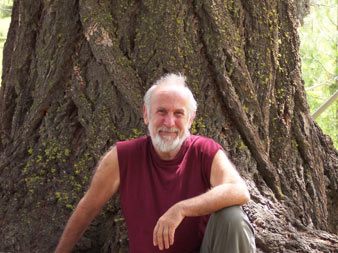
John Seed needs no introduction as he is a well known face of rainforest activism. Having worked for 30 years for the protection of rainforests worldwide, John is still going strong in his message to protect our living Earth.
What is remarkable about his life story is that he did not drop from the sky. He was an ordinary human being and a normal person like you and me. He still is. He has a life, loved ones, fears, and his share of daily grind; just like we all do. But he had the courage to keep it all aside and dive head long into the ideals that grew in him.
He did not start with a big bang or an NGO. He simply tagged himself with the causes he could feel within and connect to. He learnt on the fly. He learnt what he was fighting about, after getting involved in the fight. All he had was a bit of conviction that he was doing the right thing. He did come a long and is raring to go for more.
As a part of his lecture tour to India, John Seed has been travelling all over the country talking about Deep Ecology, Rainforest Conservation, and his past works in different parts of the worlds. His talk in Chennai was centered on the efforts in stalling development of neutrino observatory, and various ecological conservation work undertaken in different parts of the world.
John Seed’s Role in Stalling the Neutrino Observatory in Niligiri Biosphere, Tamil Nadu
India-based Neutrino Observatory (INO) was a proposed particle physics research project to study atmospheric neutrinos in a large deep tunnel/ cave near Masinagudi in Tamil Nadu, India. It was one of the biggest experimental particle physics projects to be undertaken by multiple institutions, for the first time in India. The proposed project location falls near the Mudumalai Wildlife Sanctuary (Tamil Nadu) which is rich in wild biodiversity putting two tiger reserves and elephant corridor at Singara, at risk.
As a part of the experiment, more than 2 kilometer tunnel would have been constructed to build an underground 100,000 ton neutrino detector. This Neutrino Observatory was planned to be constructed in the heart of the forest region of Singara, the Nilgiri Biosphere Reserve (NBR).
Within the Niligiri Reserve lie six protected areas (PAs) – The Wynad Wildlife Sanctuary, Nagarhole National Park, Bandipur National Park and Mudumalai Tiger Reserves and the Mukurthi National Park and Silent Valley National Park. All these protected areas which house rare and endangered species, including the Tiger. Large tracts of reserve forests connect these different National Parks and Sanctuaries and form more or less continuous forests from the animal’s point of view.
Immense care would have been required during construction and operation phase as the area is a corridor for the movement of Elephants. The proposed site’s access road was cutting across a vital elephant corridor that connects the Eastern Ghats and Western Ghats. Needless to say that this project would have spelt doom to the elephant, tiger and many other animals habitats and also affecting the flora of the region.
In November 2009, the Ministry of Environment (India), denied permission for the Department of Atomic Energy (India) to set up the India-based Neutrino Observatory (INO) project at Singara.
John Seed played a major role in stalling the Neutrino Observatory project. He started his email campaign by sending letters to the project stakeholders such as the politicians, scientists, administrators, including the government. The awareness of the erstwhile unknown project caused media uproar and this project was stalled at its design stage.
Thanks to John Seed and many more environmentalists and activists like him, many species of the Niligiri were saved from intrusion and gradual extinction. John Seed’s work towards ecological conservation in India had resulted in saving the Niligiri Biosphere and its fragile ecosystem.
Deep Ecology and Conservation of Nature – Lecture by John Seed in Chennai
On 26th December 2009, John Seed, as a part of his second lecture tour to India spoke about Deep Ecology. Here is introduction on his program.
Deep Ecology is a philosophy of nature, which sees that underlying the environmental crisis there is a psychological or spiritual disease stemming from the illusion of separation between humans and the rest of the natural world. The late Arne Naess, Emeritus Professor of Philosophy from Oslo University, Norway, who coined the term “deep ecology”, pointed out that our “ecological ideas are not enough to protect the Earth, we need ecological identity, ecological self”. With a presentation that includes music and poetry, John Seed shows us how to nourish our ecological identity and align ourselves with Earth.
The experience of deep ecology leads to a deepening of our love for the natural world and empowerment and vision for the protection of Nature. In the 2nd part of this presentation, John will speak of this and show a couple of short films about his projects for the protection of nature in South India including the reforestation of Arunachala in Tamil Nadu and the protection of the world’s largest remaining population of wild Asian elephants in the Nilgiris.
John Seed’s lecture was fun, interesting, enlightening and musical. We were more than happy with his rendition of songs and poems. He shared his experience in Thailand, where Buddhist monks tie a saffron cloth around a tree deeming it sacred. The wood cutters do not cut such trees. By this some trees are being saved. And in Sri Lanka, sacred grooves are earmarked and no one harms those. These are the indigenous ways in which the clergy is trying to reach out to protect Mother Nature.
He also spoke about the remarkable work undertaken by Annamalai Forest Restoration Foundation where trees were planted and protected on the mountains in an ingenious way, inspite of dry weather conditions. Thanks to efforts like these, there have been no major forest fires in Tiruamnnamalai inspite of the harsh dry climate.
He also spoke about the community therapy programs that are conducted by him and his organization that involves healing of people, sensitizing them to the environment, etc. Between Deep Ecology and paeans of love for Earth we were treated with video footage of some fabulous work by India’s ace wildlife film maker, Shekar Dattari. Here are some of the video clippings.
Reweaving Shiva’s Robes
Long Live the Elephants
John Seed’s passion for Earth was felt through out session. He is one of the remarkable persons who have done their bit and continue to do so. The key messages he left for us were:
> We are trying to save the Earth now, because we are worried about us; not the Earth.
> That we live in an illusion that humans are central to everything on Earth.
>Earth has always said YES to human beings. It still does.
>That what happens to nature, happens to us.
>That we are living in a world of wounds – wherein its hard to think about ecology.
>That religions and religious postulates have bred in arrogance in humans since time immemorial(going by the story of creation).
>That our language deceives us to believe that we are better. And that plants and animals that do not speak are inferior.
>That you don’t have to go too far for answers. Nature is explanation itself.
Here are some of the soul warming songs that John Seed sang and strummed in Chennai at the Book Point Auditorium (Anna Salai):
>I just wanna celebrate; celebrate life…
>Now the Lord made the world in just six days
>Love Song to the Universe – Remember that you are standing on a plant that is evolving…
>Ode to the Mother – I was once blind…
You can find the lyrics and music notes of these poems and songs and a collection of more soul warming songs on his website.
To know more about John Seed, the founder and director of the Rainforest Information Centre in Australia, please visit his Rainforest Information Website