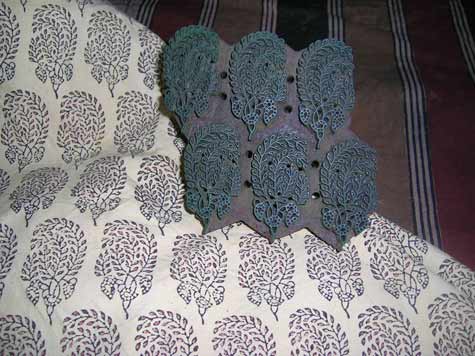
Bagru, an erstwhile sleepy and desolate village on the Jaipur-Ajmer Road in Rajasthan, is now the cynosure of many fashion houses and boutiques.
As the world is waking up to environmental consciousness and eco-living, this little village has been attracting the attention of green moguls as one of the must-have items in your home wardrobe. What draws the crowds is its ancient art and craft form that is high on ecological consciousness and for its use of eco-friendly hand block printing practices.
Bagru boasts of a handful of crafts persons who still use traditional vegetable dyes in their hand block prints. Bagru’s method of printing is completely eco-friendly. From treating the base cloth with Fuller’s earth (multani mitti), soaking it in turmeric (haldi), to stamping the cloth with beautifully patterned blocks of wood using natural dyes of earthy hues, Bagru’s prints are epitome of eco-friendly textiles and printing practices. Added to that, natural coloring agents such as alum, turmeric, pomegranate, dried flowers, indigo, etc are used to add colorful designs and motifs to the fabric. Blue from indigo, green from indigo mixed with pomegranate rinds, red from madder root and yellow from turmeric. It can’t get any more eco-friendlier than this.
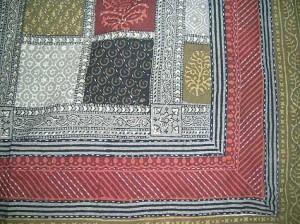
Since India is rich and abundant in its natural resources, most of its arts and craft forms derive raw materials and design influence from nature. Almost all the ancient art forms are eco-friendly and mostly celebrating nature. Bagru’s hand block printed fabric is no exception. From vegetable dyes, natural fabrics, nature-inspired patterns and design, its products are ecologically natural.
Bagru prints are so unique and renowned that the Calico Museum of Textile in Ahmedabad, India, has commissioned a study into this old art form. Thanks to this kind of interest in ecofriendly printing practices, the village now hums with much activity: stamping, printing, dyeing and supplying the exquisite art form to different corners of the world.
In spite of poor living and working conditions, the expert craftsmen of Bagru have kept the three-centuries-old tradition of block printing alive in India. Thanks to them, we now get to witness and ancient art form that shows how man lived in symphony with nature without harming the environment and oneself.
History of Bagru Hand Block Printing
There is no authentic record for reference on backdating Bagru’s block printing practices. It is estimated that this art form was introduced 450 years back when a community of Chhipas (literally meaning people who stamp or print) came to Bagru from Sawai Madhopur (Alwar), and settled in Bagru. Even today, their community works together in a place called Chhippa Mohalla (Printer’s Quarters), by the Sanjaria riverside. It is perhaps the river name that lends it name to Sanganeri printing art form.
The Chippas community settled along the riverside, like any other nomadic settlement. The bank of the river provided then with clay which is an important ingredient in getting the base color of the famed Bagru prints. The artisans smear the cloth with Fuller’s earth got from the riverside and then dip it in turmeric water to get the beige colored background. After that, they stamp the cloth with beautiful designs using natural dyes of earthly shades.

Eco Friendly Colors used in Bagru Hand Block Printing
Bagru prints are done on off-white, ivory white, or beige background. The main colors used in Bagru printing are black, red and maroon. These three main colors are extracted from naturally occurring sources: black is derived from worn-out iron horse or camel shoes soaked in water, red comes from gum paste and phitkari, and maroon is a result of mixing the above two colors.
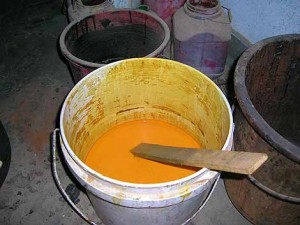
Apart from these base colors, natural vegetable dyes are used to add colorful patters and designs. These include madder, indigo, pomegranate rind, turmeric, etc. Pigment colors such as green, rust, blue, violet, brown, and pink are added to appease wider markets. There is also a traditional reason for picking a particular color in the designs, such as indigo for Lord Krishna, saffron for a saint or yogi, yellow for spring season, etc.
Bagru Hand Block Printing Process
Bagru’s method of hand block printing is a labour-intensive process that requires a lot of, skill, patience, effort and time.

The wooden blocks used for printing a design on the fabric are hand-made using traditional fine-carpentry tools. Some blocks are made of teakwood while some use light-weight wood called Rorda. These blocks are soaked overnight in oils, washed and then put to use. Usually, over a period of time, the Chhippas have considerable amount of blocks collection which they consider as their core wealth.
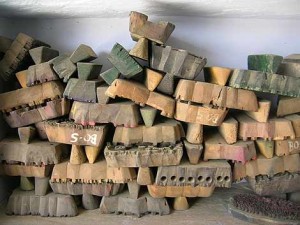
The base cloth on which the block printing is done is prepared with riverside clay, turmeric, and other solutions to make it softer and absorbent. It is then dried and washed whilst acquiring a dull white or light beige color. This color background is one of the distinctive characteristics of Bagru hand prints.
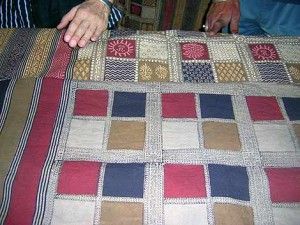
The vegetable dyes are prepared as per family traditions that have been passed from generation to generation. The printer dabs the block in the dye and stamps the design outline on the fabric as per the pattern template. Single measured dab is required for one stamp. There are no hi-fi tools to stamp but simple human judgment in assessing the amount of color required and in placing the block on the fabric. This imperfect yet neat stamping process lends it own unique charm to the design and product.
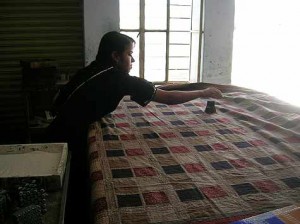
Once the cloth has been printed, it is dried in the sun and then readied for dyeing. The design outlines are then filled with other color dyes with the help of complimentary hand blocks that are carved to fill the hollow spaces created by the outlined design blocks.
After printing, washing, and dyeing, the cloth is given a final wash and is sun-dried.
Difference between Sanganeri and Bagru Prints
Whilst both the eco-friendly printing forms belong to Rajasthan and use hand blocks, Sanganeri prints are usually done on bright colored fabric as a base. Sanganeri prints are found on bright white background whereas Bagru prints are done on black, brown, beige, and red back grounds. Sanganeri prints are mostly floral trellis like patterns whereas Bagru prints have motifs and geometrical inlays.
Difference between Dabu printing and Bagru Printing
Dabu printing is also a unique art form found alongside Bagru prints. In this, a design is sketched onto the background cloth. This sketched design is covered with clay on which saw dust is sprinkled. The saw dust sticks to the cloth as the clay dries. Thereafter, the entire cloth is dyed in select colors. The area where clay and sawdust mixture is present does not catch the dye and remains colorless. After dyeing and drying, the cloth is washed to remove the clay and the mixture. For additional color, this cloth is dyed again in a lighter shade to cover the patterned area. This unique form of printing is also environmentally non-toxic and uses no harmful or synthetic dyes.
The Dark Side of Bagru Block Printing
Like any other trade, Bagru’s block printing also comes under considerable flak for its adultery in art form. While retailers sell Bagru products at a premium price, a fraction of this reaches the actual workers. The printers are looking out for cheaper, faster options of increasing the output – putting this trade at a risk.
Market demand, poverty, poor living and working conditions have forced these craftsmen to resort to trade shortcuts that range from using synthetic dyes, machine cut tools, to fabrics of sub-standard quality.
The Future of Bagru Printing
Bagru block printing has evolved over a period of time accommodating to changes in lifestyle, demand and fashion. Since ancient and exotic art forms had taken a back seat due to western influence and globalization, many Chhippas have given up the art of hand block printing as people have adopted modern and synthetic textiles. Yet there are a handful of craftsmen who swear by the beauty of the art form and equate their work to worship.
While traditional art forms and methods are increasingly being replaced by modern tools, techniques and synthetic dyes, Bagru prints are finally getting recognized. With attention back on preserving the near extinct art forms, there is a revived interest in preserving the rare art of hand block printing with vegetable dyes.
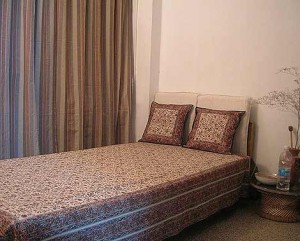
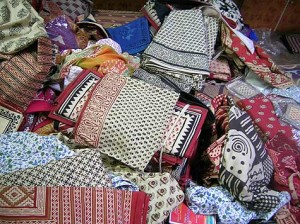
Bagru prints are unique, captivating and exotic. Erstwhile used for clothes and turbans, Bagru textiles are increasingly in demand for home furnishings and décor. Bagru prints and motifs are preferred for bed spreads, bed sheets, table linen, and home accessories.
Bagru prints are here to stay. As people around the world are increasingly becoming environmentally conscious, soft-on-nature art forms are once again back in demand. Many block printers may now follow Bagru’s example of stamping it right.
Resources on Bagru’s Famed Hand Block Printing
For more information on Bagru Hand Block Printing process – click here and here is a lovely collection of some beautiful and exotic motifs of Bagru Block printing
This article is based on a visit to Bagru Village, Rajasthan, for Hand Block Printing. We deeply appreciate the hospitality of the Hand Block printers, their families and other villagers – as we continue to admire their works of art which now adorn our home.
On our way back, we came across a heart-warming sight – a bunch of kids were studying under a lone tree in the desert, which is their makeshift school. The need of the hour is support in terms of infrastructure, education, finance, etc, for upliftment of the Bagru community.
For information on reaching Bagru or buying thier merchandise, get in touch with us.
.